
Problem Definition
What is the objective of the risk analysis?
Building a common understanding regarding the system under observation
Illustrating the inputs, components and effects
Using function block diagrams, flow diagrams or tree diagrams

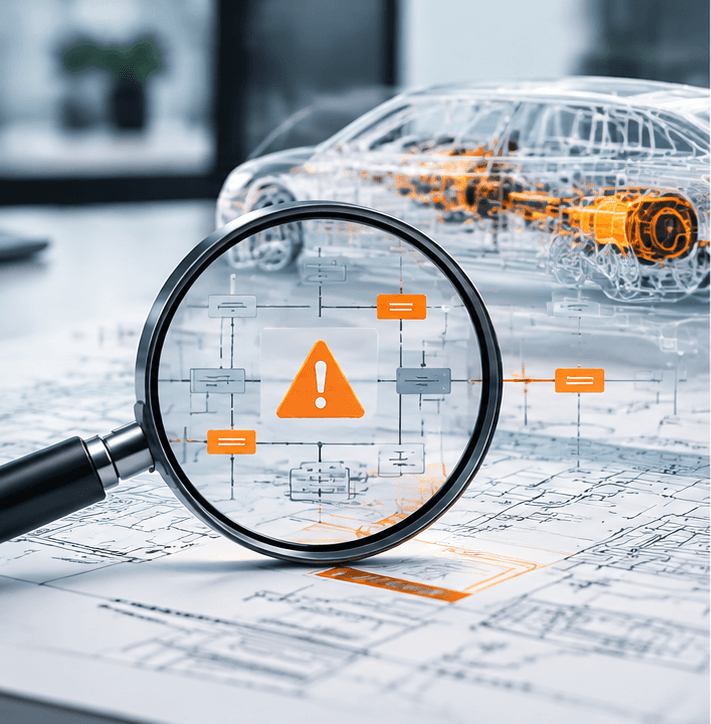
Risks in technical developments have to be identified in order to be calculable. Risk analyses help to come to an appropriate conclusion on the expected risks and they provide approaches to minimize the risks. They are used preventively for failure avoidance or reactively for failure elimination. Common methods besides FMEA and FTA are the risk filter, quality evaluations and DRBFM.
Risks in technical developments must be identified and systematically evaluated before they can be effectively controlled. Our engineering approach applies structured risk analysis methods to identify hazards, assess failure mechanisms, evaluate technical impact, and implement targeted corrective actions throughout the product development lifecycle.
Using proven methodologies such as FMEA, FTA, DRBFM, quality evaluations, and risk filtering, we help organizations reduce development risks, improve product reliability, and support informed engineering decisions.
Professional engineering support using structured risk analysis methodologies.
Supporting systematic analysis workshops and complete documentation.
Managing and coordinating the complete technical risk analysis process.
What is the objective of the risk analysis?

What are the causes and what are the interactions?

Which actions are suitable to eliminate the risks?
Technical risk analyses enable organizations to identify potential failures before they become critical issues. Through structured engineering methods, systematic evaluation, and preventive planning, risks can be minimized while improving product reliability, reducing development costs, and supporting informed technical decision-making.
Whether you require structured risk evaluation, FMEA and FTA support, DRBFM implementation, or complete technical risk management throughout development, our specialists help identify, analyze, and minimize engineering risks.